Service providers

Essential information for service providers working with Local Guardians clients, including registration, shift notes and compliance.

Index Getting registered
  1. Getting registered
    1. What does a service provider need to register with Capital Guardians?
    2. What compliance documents are required from providers?
    3. How do I add additional staff members to my provider profile?
    4. How do service item codes work?
  2. Invoicing and payments
    1. What are shift notes and who needs to submit them?
    2. Do cleaning, gardening or allied health providers need to enter shift notes?
    3. Will a client be able to use their worker if shift notes are not submitted?
    4. How do I avoid payment disputes or invoice rejections?
  3. Incidents and compliance
    1. How are incidents reported by service providers?

Getting registered

This information is for service providers working with Local Guardians clients.

What does a service provider need to register with Capital Guardians?

Service provider working on garden

We partner with Capital Guardians and use their financial management / payment platform to minimise administrative costs and pay service providers weekly (up to a month earlier than when we receive funding from the Government).

All service providers must register in Capital Guardians, and upload their invoices regularly.

Other requirements/considerations include:

  • Must have an ABN, a valid police check (less than 3 years old), and public liability insurance.
  • Providers cannot be family members, Power of Attorneys, Support at Home funding representatives, or live in the same home.
  • Transport services require a driver’s license and comprehensive car insurance.
  • Additional qualifications may be needed for specific tasks (e.g., nursing).
  • Compliance documents are not needed for in clinic services, consumables, or equipment.
  • Providers must complete a ‘Service Provider Agreement’.
  • One-off tradespeople are exempt from police checks if accompanied by another person but still need public liability insurance.

What compliance documents are required from providers?

Support worker helping senior lady

Police Checks, Insurance and Qualifications

Police checks are mandatory for service providers who are visiting the client in or at their home.

In-home service providers must have a valid police check that is less than 3 years old (as required in the Aged Care Act 2024 and Aged Care Rules 2025), that does not preclude the individual from working in aged care.

Police checks are not required for service providers providing a once-off service/trade in the home, who are supervised by someone else other than the care recipient.

Compliance documents are not required for in-clinic services, such as a physio clinic, consumables or equipment.

Allied health professionals delivering services in the home will need to register in Capital Guardians and upload their public liability insurance and their police check. This applies to Allied Health who are registered with AHPRA, as they do not collect a copy of the police check or record the expiry date.

$5m public liability Insurance is required by all service providers attending the client’s home.

For transport services, a driver’s license and comprehensive car insurance are necessary.

Appropriate qualifications are required depending on the type of work being conducted. For example, a person providing nursing care or administering medication must be qualified to do this.

All compliance documentation must be provided prior to an individual commencing work. If a provider is engaged prior to having valid compliance checks in place, it is considered a private arrangement.

Table Summary

Service Type Police Check Requirement Insurance Requirement Qualifications Required Additional Notes
In-home service providers, delivering direct client care Mandatory, valid < 3 years, in compliance with Aged Care Act $10m public liability Dependent on service provided (e.g., nursing care requires specific qualifications)
  • NDIS screening is accepted as Police clearance.
  • Work with Children is not accepted.
  • Workcover or personal insurance is not accepted.
In-home service providers, domestic cleaning and gardening Mandatory, valid < 3 years, in compliance with Aged Care Act $5m public liability NA
  • NDIS screening is accepted as Police clearance.
  • Work with Children is not accepted.
  • Workcover or personal insurance is not an acceptable substitution.
Once-off service/trade at home Not required if supervised by someone other than care recipient Not collected by us Dependent on service provided – not collected by us If the job is significant, e.g. bathroom modification, normal insurance and police check requirements will apply.
Allied Health delivered in HOME Mandatory, valid < 3 years, in compliance with Aged Care Act $10m public liability AHPRA registration to be checked by CG for validity
  • AHPRA registration does not replace a police check – AHPRA do not collect or validate police checks.
  • NDIS screening is accepted as Police clearance.
  • Work with Children is not accepted.
  • Workcover or personal insurance is not accepted.
  • In the event police checks are unable to be provided, escalate to line manager to ensure safe delivery of services.
  • For example, we will accept details of a National Police Check in place of a police check in NSW from healthcare staffing agencies as per HealthShare NSW advice.
Allied Health delivered in CLINIC Not required Not required Not required Compliance not needed for in-clinic services.
Consumables, e.g. meals, equipment, products Not required Not required Not required Compliance not needed for providing consumables.
Transport services Mandatory, valid < 3 years, in compliance with Aged Care Act $10m public liability Driver’s license and comprehensive car insurance
  • Does not apply to Cabcharge or taxi.
  • Ride share is not allowable.

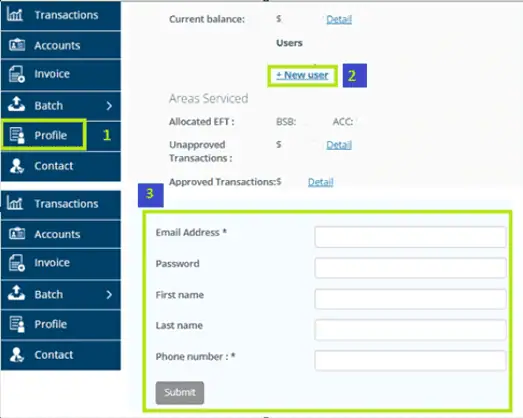
How do I add additional staff members to my provider profile?

If you have multiple staff who need to enter their own shift notes, you can easily add them to your account.

  1. Click on the PROFILE tile in your Capital Guardians login.
  2. Click on +New User.
  3. Add the details of the new user and submit.
New user on Capital Guardians

How do service item codes work?

To ensure fast and accurate payment, all invoices must include the correct Service Item Code, along with your unit price and number of units.

Each service you deliver is matched to a standard code. This tells us:

  • What type of service was delivered
  • Which funding category it sits under (Clinical, Independence, Everyday)
  • How it should be claimed and paid

What you need to include on every invoice

For each line item, please include:

  • Date of service
  • Service Item Code (from the table below)
  • Service description (what you delivered)
  • Unit price (your agreed rate)
  • Units (e.g. hours, visits, or quantity)
  • Total amount

Example:

22/04/2026 SERV-0001 – General house cleaning

2 hours @ $65/hour = $130

How to choose the right code

Use the table below to match your service to the correct code.

A simple way to think about it:

  • Clinical: Personal care, Nursing, allied health, care management
  • Independence: Social support, transport, equipment
  • Everyday: Cleaning, meals, home maintenance

If you’re unsure, choose the code that best reflects what you actually did, not your job title.

Important notes

  • One service = one code per line (don’t bundle multiple services together)
  • Use the most specific code available
  • Incorrect or missing codes will delay payment
  • If a service spans multiple categories, split it into separate line items

Support at Home codes

Common service codes include:

  • Personal care (showering, dressing): SERV-0020
  • Cleaning: SERV-0001
  • Transport to appointments: SERV-0016
  • Physiotherapy: SERV-0034
  • Gardening: SERV-0004

The complete list of Support at Home service codes is provided below.

Service Code Service Description Service Area Funding Category
Clinical Supports
SERV-0023 Registered nurse clinical care Nursing Clinical
SERV-0024 Enrolled nurse clinical care Nursing Clinical
SERV-0025 Nursing assistant clinical care Nursing Clinical
SERV-0026 Nursing care consumables Nursing Clinical
SERV-0027 Allied health assistance Allied health Clinical
SERV-0038 Counselling or psychotherapy Allied health Clinical
SERV-0039 Music therapy Allied health Clinical
SERV-0031 Diet or nutrition Allied health Clinical
SERV-0032 ATSI Health Practitioner assistance Allied health Clinical
SERV-0033 ATSI Health Worker assistance Personal care Clinical
SERV-0036 Exercise physiology Allied health Clinical
SERV-0037 Occupational therapy Allied health Clinical
SERV-0034 Physiotherapy Allied health Clinical
SERV-0028 Podiatry Allied health Clinical
SERV-0035 Psychology Allied health Clinical
SERV-0029 Social work Allied health Clinical
SERV-0030 Speech pathology Allied health Clinical
SERV-0018 Home support care management Care management Clinical
Independence Supports
SERV-0020 Assistance with self-care and activities of daily living Personal care Independence
SERV-0021 Assistance with the self-administration of medication Personal care Independence
SERV-0022 Continence management (non-clinical) Personal care Independence
SERV-0009 Group social support Social support Independence
SERV-0010 Individual social support Social support Independence
SERV-0011 Accompanied activities Social support Independence
SERV-0012 Cultural support Social support Independence
SERV-0013 Digital education and support Social support Independence
SERV-0014 Assistance to maintain personal affairs Social support Independence
SERV-0015 Expenses to maintain personal affairs Social support Independence
SERV-0040 Acupuncture Therapeutic services Independence
SERV-0041 Chiropractics Therapeutic services Independence
SERV-0042 Diversional therapy Therapeutic services Independence
SERV-0043 Remedial massage Therapeutic services Independence
SERV-0044 Art therapy Therapeutic services Independence
SERV-0045 Osteopathy Therapeutic services Independence
SERV-0047 Nutrition supports Allied health Independence
SERV-0048 Flexible respite Personal care Independence
SERV-0049 Community and centre based respite Personal care Independence
SERV-0016 Direct transport Transport Independence
SERV-0017 Indirect transport Transport Independence
SERV-0061 Managing body functions Equipment and products Independence
SERV-0062 Self-care products Equipment and products Independence
SERV-0063 Mobility products Equipment and products Independence
SERV-0064 Domestic life products Equipment and products Independence
SERV-0065 Communication and information management products Equipment and products Independence
SERV-0066 Assistive technology prescription and clinical support Equipment and products Independence
SERV-0067 Home modification products Home modifications Independence
SERV-0068 Home modifications prescription and clinical support Home modifications Independence
Everyday Supports
SERV-0001 General house cleaning Domestic assistance Everyday
SERV-0002 Laundry services Domestic assistance Everyday
SERV-0003 Shopping assistance Domestic assistance Everyday
SERV-0004 Gardening Home maintenance and repairs Everyday
SERV-0005 Assistance with home maintenance and repairs Home maintenance and repairs Everyday
SERV-0006 Expenses for home maintenance and repairs Home maintenance and repairs Everyday
SERV-0007 Meal delivery Meals Everyday
SERV-0008 Meal preparation Meals Everyday

Invoicing and payments

What are shift notes and who needs to submit them?

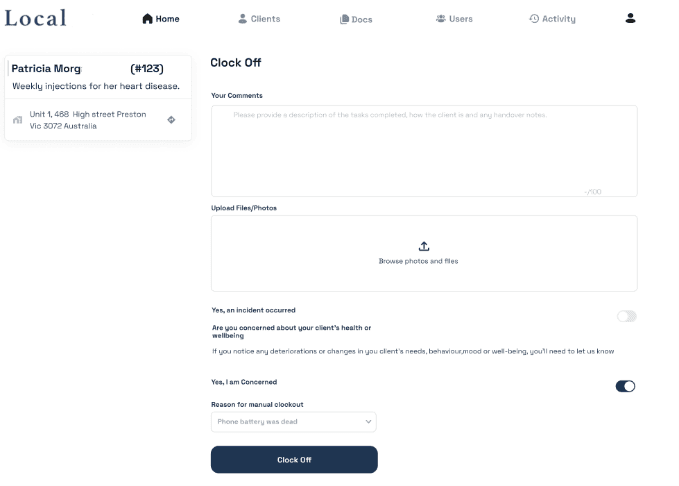
A shift note is a short-written summary, describing what was done during a shift. It also notes anything important about how the recipient is doing or if there are any concerns about wellbeing or condition.

Why are shift notes important?

Shift notes serve as more than just a compliance requirement. They act as a safety net for both the client and support worker, fostering collaboration among support workers to address concerns promptly, averting potential serious situations.

They are a record of services provided in case of a complaint, incident or dispute.

During emergencies, they become invaluable, providing critical information for immediate and necessary care.

Should there be a discrepancy around the arrival to a shift or the work completed, well-maintained shift notes act as a record confirming the services rendered on that particular day. This serves as a reliable reference, clarifying any uncertainties about the services provided.
Shift notes Local Guardians

What is typically included in shift notes?

Typically, a shift note will include details of the support provided (or rejected), highlighting key activities and outcomes achieved during the shift. This validates that the activities delivered align with the specific services that were scheduled.

The following items should be included in a shift note:

  • Name of the support worker (if this isn’t the same as the company name)
  • Date of service
  • Start and finish time
  • Brief description of tasks completed
  • Any concerns about the client’s condition, such as a change in behaviour, mood, appetite or mobility

When should shift notes be entered?

Shift notes should be entered promptly to ensure accurate recollection of events and timely responses.

Voice-to-text features on mobile devices can be used to capture notes before they are transferred into Capital Guardians.

Bulk uploads of shift notes on a weekly or monthly basis are not permitted, as delays can hinder quick action in response to adverse events and lead to serious consequences.

Can I charge the Support at Home funding for entering shift notes?

Charging an admin fee for inputting shift notes isn’t permissible through the Support at Home funding. Documenting shift notes is a common practice across various industries, be it healthcare, trades, or beauty services. Maintaining a record of events is crucial for optimal client outcomes and conflict prevention.

Keeping shift notes concise and focused is key. It is not intended to be a full report.

Who will be able to view shift notes?

The following people have access to client shift notes. It is therefore essential that they are professional, objective, timely and accurate.

  • The Local Guardians team who are managing the Support at Home funding account and approving invoices.
  • The Local Guardians management and clinical team if reviewing an incident, complaint or concern.
  • In some circumstances, Local Guardians may be legally obligated to disclose your shift notes to a legal or regulatory body.

Do cleaning, gardening or allied health providers need to enter shift notes?

Cleaning house

Yes, any services provided through the Support at Home program require a shift note. A brief description of the tasks you completed with any relevant comment on the welfare of the client (if you saw them) is sufficient. This may be as little as a few sentences.

A full report or health summary (for Allied Health) is not required.

Will a client be able to use their worker if shift notes are not submitted?

Unfortunately no. Shift notes are a legislative requirement and must be completed by support workers who provide services under the Support at Home Program.

If you require assistance in sourcing a new provider, you can use this Provider Search or get in touch with your Care Advisor.

How do I avoid payment disputes or invoice rejections?

Shift notes are a legislative requirement and must be completed by support workers who are funded through the Support at Home Program. In the absence of shift notes, the services cannot be continued or paid for with Support at Home funding.

Consistent and detailed shift notes are key to avoiding payment issues. Incomplete or mismatched notes might result in invoice rejections.

Incidents and compliance

How are incidents reported by service providers?

All incidents, hazards, or near misses should be documented in shift notes and reported using our incident form. When in doubt about whether something qualifies as an incident, it’s advisable to submit it for review. It’s always better to err on the side of caution in these situations.

Incident

Still have a question?

Talk to your local Care Advisor. Call the number for your state or email customer@localguardians.com