

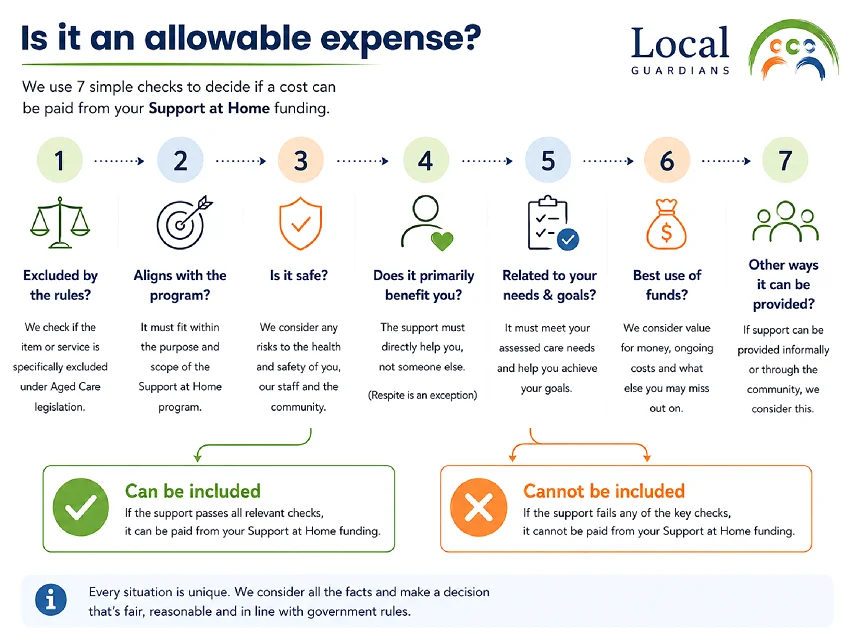
When making decisions about Support at Home funding inclusions and exclusions and how funds can be spent we take time to consider the Decision Making Process, which covers considerations such as:
Although there is some uncertainty, the Department of Health and Aging is very clear on stating that Support at Home funding:
In addition, all Support at Home spending:
Absolutely! We’ve created two separate webpages covering Home Care Package inclusions and exclusions. Click the links below to visit these pages.
https://localguardians.com/home-care-package-exclusions/
** Note this information is currently in the proces of being updated to reflect the new Support at Home Program
** Note the below information is currently being updated in line with the new Support at Home Program
In order for aids or equipment to be approved
In most cases any aids or equipment will need a recommendation from the appropriately qualified allied health professional, this is generally an Occupational Therapist, but might be a Physio or Registered Nurse depending on the equipment.
Aids and equipment purchases MUST be:
Aids and equipment purchases must NOT be:
Click here to find out more about equipment approval timeframes.
All items need to be in the care plan and budget prior to committing any funds, this is the opportunity to discuss the expenditure with your Care Advisor. If there is additional information needed or specialist recommendations required, this will be communicated to you. Providing a detailed description will assist in assessing if the expenditure is allowable. You will be notified by your Care Advisor if the expenditure has been approved.
If we determine that the expenditure is not in scope for the package, we will discuss the reason why with you. We can also provide a written explanation of why the item was rejected.
If you are not satisfied with this outcome you may wish to seek assistance for dispute resolution from an independent advocacy service. The Aged Care Advocacy Service accepts enquiries at www.opan.com.au or 1800 700 600.
Should you wish to appeal the decision or make a complaint, contact the Aged Care Quality and Safety Commission: https://www.agedcarequality.gov.au/ . The Commission’s telephone number is 1800 951 822.
Allowable expenditure is one of the biggest minefields for approved providers. There is always new information and clarifications on inclusions/exclusions being released. Different providers adhere to the expectations to varying degrees, meaning that there are discrepancies between what clients have approved with different providers. Even with the same provider an item that was approved in the past, may no longer be approved.
Despite there being many items that can’t be included in the package, there are still plenty of opportunities for clients to fully utilise their funding. If you need assistance with ideas, you can consult the Allowable Expenditure – Inclusions Page and/or contact your Care Advisor who can work through your needs to see what else can be included.
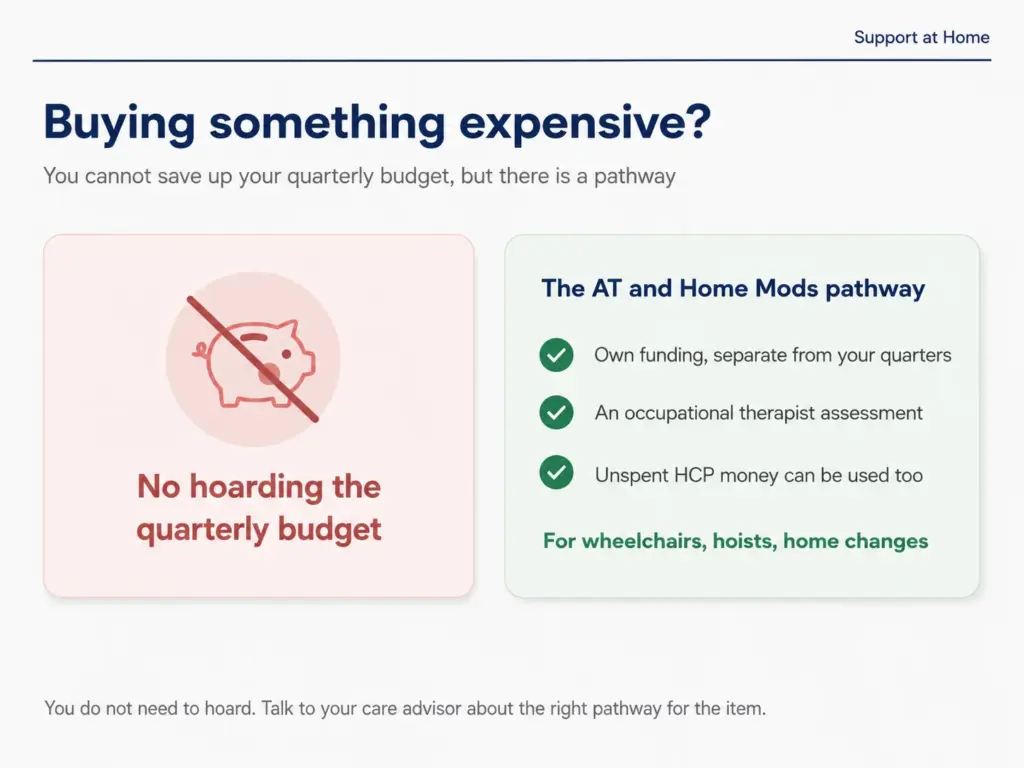
Not from your quarterly budget. Support at Home is designed to fund the care and services you need now, not to be saved up. Each quarter only carries a small amount forward, the higher of $1,000 or 10% of that quarter, and anything above that goes back to the government.
If you need an expensive item like a wheelchair, hoist or home modification, that is funded a different way:
So you do not need to hoard your budget. Talk to your care advisor about the right pathway for the item you have in mind.