

Understand any personal costs you may need to pay and what your funding covers.
If you’re receiving Support at Home Funding (from 1 November 2025), you receive a government budget to help you live safely and well at home.
Most people will also pay a personal contribution, a percentage of the cost of some services. This is not a penalty, it is how the program is designed so that people who can afford to contribute, do so fairly.
Your Support at Home budget works like “buckets of support”, into three broad buckets:
Each bucket works a little differently when it comes to your contribution.
| Type of Support | What is it? | What Will You Pay? |
|---|---|---|
| Clinical (health) | Services that protect your health, safety, and wellbeing. They are often delivered by qualified professionals.
Nursing care, physiotherapy, care management, consumables (medical supplies), dietitian/nutritionist, occupational therapy, podiatry, psychology, speech pathology, exercise physiology, counselling, social work, music therapy, Aboriginal and Torres Strait Islander health supports. |
0% |
| Independence | Services that help you stay independent, connected, and able to manage day-to-day life.
Personal care, social support, transport, help with showering, dressing, toileting, help taking medication, continence support, social, community and cultural support, digital support (learning to use phones, tablets, email), help managing personal affairs (paperwork, bills, appointments), therapies that support wellbeing (not strictly medical), acupuncture, chiropractic, massage, art therapy, osteopathy, diversional therapy, respite, special cushions or continence products, home modifications, equipment and aids (walking frames, shower chairs, grab rails), assistive technology. |
Between 5-50% |
| Everyday | Services often recognised as “home help”. Most people do pay a contribution toward everyday services because these are things many people would normally pay for privately if they didn’t have Support at Home.
House cleaning, laundry, shopping help, home maintenance minor repairs, gardening, meals. |
Between 17.5%-80% |
What does “percentage contribution” really mean?
Your personal contribution is the portion of the service cost that you pay yourself.
For a service costing $100:
| Your Contribution Rate | You Pay | Your Funding Pays |
|---|---|---|
| 0% | $0 | $100 |
| 5% | $5 | $95 |
| 17.5% | $17.50 | $82.50 |
Support at Home is designed to balance government funding with fair personal contributions, so people who can afford to contribute do so, while essential health care remains protected. How much you pay depends on the type of support you use and your income and assets, not a one-size-fits-all fee. Understanding these differences can help you plan with confidence and make informed choices about your care. Our interactive Support at Home budget planner is a simple guide to help you see how your funding and contributions may work in practice.
Support at Home Budget Planner
https://localguardians.com/understanding-support-at-home-and-personal-contributions/
Under Support at Home, the amount you contribute depends on:
Clinical services are fully funded by the Australian Government, regardless of your pension status. Contributions apply mainly to independence and everyday living services.
| Your Financial Status | Clinical Services | Independence Services | Everyday Living Services |
|---|---|---|---|
| Full Pensioner | 0% | 5% | 17.5% |
| Part pensioner or self-funded Commonwealth Seniors Health Card holder | 0% | Between 5% and 50% | Between 17.5% and 80% |
| Self-funded retiree without a Commonwealth Seniors Health Card | 0% | 50% | 80% |
| Income and assets not disclosed | 0% | 50% | 80% |
For part-pensioners and Commonwealth Seniors Health Card holders, the exact percentage is calculated on a sliding scale based on the income and assets assessment completed by Services Australia or, where applicable, the Department of Veterans’ Affairs.
Your contribution is paid in addition to the government subsidy. It does not come out of your government-funded portion of the service cost.
Full pensioners pay the lowest standard contribution rates:
Part pensioners and self-funded Commonwealth Seniors Health Card holders pay rates based on their assessed income and assets:
The exact rate is not determined by pension status alone. Services Australia applies a tapered rate based on the outcome of your individual assessment.
Self-funded retirees who are not eligible for a Commonwealth Seniors Health Card generally pay the maximum standard rates:
A person who does not receive a pension may still qualify for a lower contribution rate if their assessed income and assets are comparable to those of a pensioner. They must provide their financial details to Services Australia for this to be considered.
Completing an income and assets assessment is not compulsory. However, if Services Australia does not have your current financial information and you choose not to provide it, you will be classified as *means not disclosed* and charged the maximum contribution rates. Clinical services remain fully funded:
Clinical services remain fully funded.
Full and part pensioners will generally have their rates calculated using information already provided for their pension assessment.
Commonwealth Seniors Health Card holders and self-funded retirees may need to complete the Support at Home Calculation of Your Cost of Care form, SA456, if Services Australia does not already hold current financial information.
For couples, half of the couple’s combined income and assets is included in each person’s assessment. The principal family home is exempt from the Support at Home assets test.
Once the assessment is completed, Services Australia will send a fee advice letter confirming the contribution rate for each service category.
You can use the Local Guardians Support at Home Budget Planner for a general estimate. Your official contribution rate will be determined by Services Australia following your income and assets assessment.
The My Aged Care Support at Home fee estimator can also provide an estimate using your pension status, income, assets and expected service costs.
The Wallet is a small reserve of your own money we hold to pay your care providers on time.
Think of it like a float. Instead of billing you each time an invoice arrives, we keep a buffer ready so payments go out smoothly without delays. The money is held safely in trust, it is always yours.
The buffer is usually around two weeks’ worth of your expected contributions. You don’t manage it. We handle everything.
When the balance drops below the minimum, it is topped up automatically by direct debit. You’ll get a notification each time.
We can’t notify you a few days in advance, top-ups are triggered by invoices as they arrive, and those can’t be predicted ahead of time.
Based on experience managing packages for thousands of clients, we suggest rounding up to:
This is not a requirement. The exact minimum can be requested to be different, just be aware it may result in more frequent top-ups, sometimes on consecutive days, and will delay service provider payments.
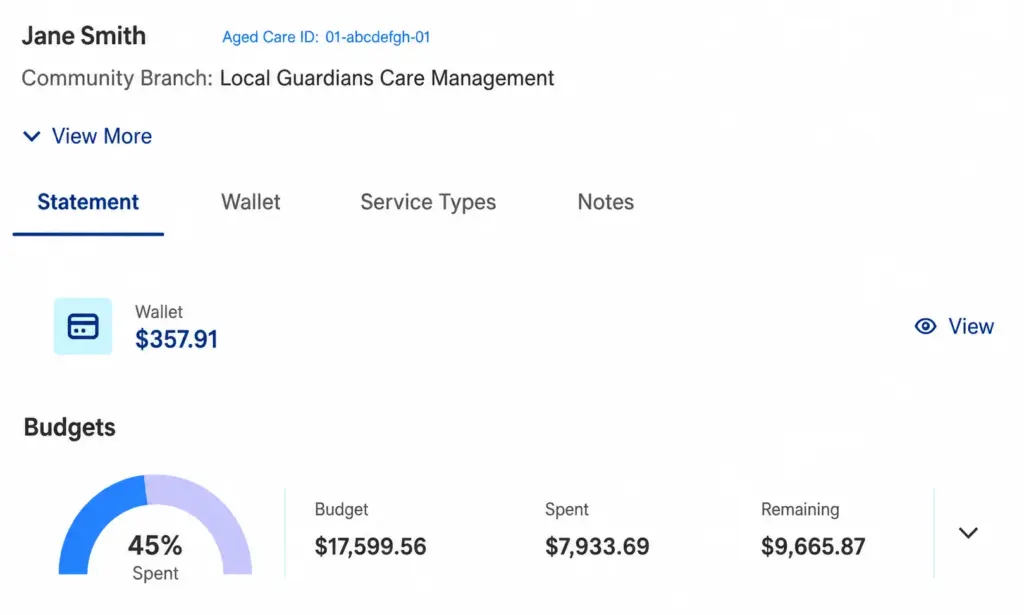
Invoices don’t arrive evenly, some weeks are quiet, others have several at once. A slightly higher, rounded buffer means fewer top-ups (average 13 per year, considering the direct debit is a four week budgeted value), no back-to-back direct debits, ensuring fast service provider payments and a simple amount that’s easy to remember.
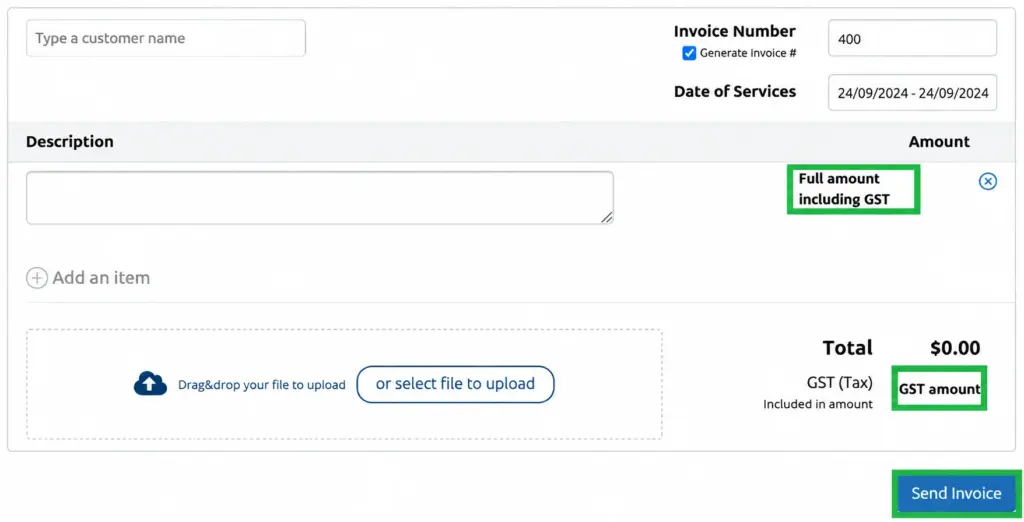
GST on goods and services provided under Support at Home cannot be paid directly from the Support at Home funding. Instead, GST should be clearly identified when invoices are uploaded, allowing Local Guardians to manage the GST payment separately.
This ensures that the GST portion is not drawn from the Support at Home funding, preserving those funds for the recipient to allocate towards additional care and services.
The full invoice amount, including GST, is paid to the service provider or reimbursement account in one deposit.
https://localguardians.com/faqs/how-is-gst-managed-through-the-home-care-package/
https://localguardians.com/faqs/personal-financial-contributions/
The 10% also works a bit like insurance. Care management is a mandatory government defined service, and everyone must receive it. Some people will need more support than others, and when that happens, the provider must still deliver the care management required, even if the time spent goes beyond what can be paid for.
Because we don’t employ care staff or earn a margin from care services we add a 10% Administration Fee to each service provider invoice. This covers the costs associated with being a Registered Provider: things like quality, compliance, governance, payment processing and support. None of this can be covered by Care Management billing and is what keeps Local Guardians running behind the scenes.
Important: You only pay this fee when you receive services. If you’re not using your funding in a particular period, there are no fees charged.
As an example, a traditional ‘full service’ provider (who has their own care workforce) might charge $90/hour for a support worker. With us, you can engage a support worker of your choice for $50/hour + our admin fee ($5), totaling $55/hour. That’s $35 less per hour, resulting in significantly more care hours from the same budget.
Under the Support at Home program, personal contributions are only applied when services are actually used. This is fairer than the previous system, where a fixed fee was charged regularly regardless of service use.
To support timely payment of your service providers, a Wallet is maintained with a minimum balance (generally around two weeks of expected personal contributions), held safely in trust. If the balance falls below this level, it is automatically topped up by direct debit. Any unspent balance always remains your money and is fully refundable if you leave.
Because contributions are triggered when invoices are received and claimed (which may be after the service date), amounts can vary from month to month. The Wallet helps smooth these timing differences, reduces unexpected bills, and ensures providers can be paid promptly alongside government funding.
Importantly, each time a top-up notification is issued, you retain visibility and decision-making over contribution-attracting expenses, as these are directly linked to the services you choose to use.
VIC & TAS: (03) 7067 0555
NSW & ACT: (02) 7227 7661
QLD & NT: (07) 2139 7090
WA & SA: (08) 6383 8819